
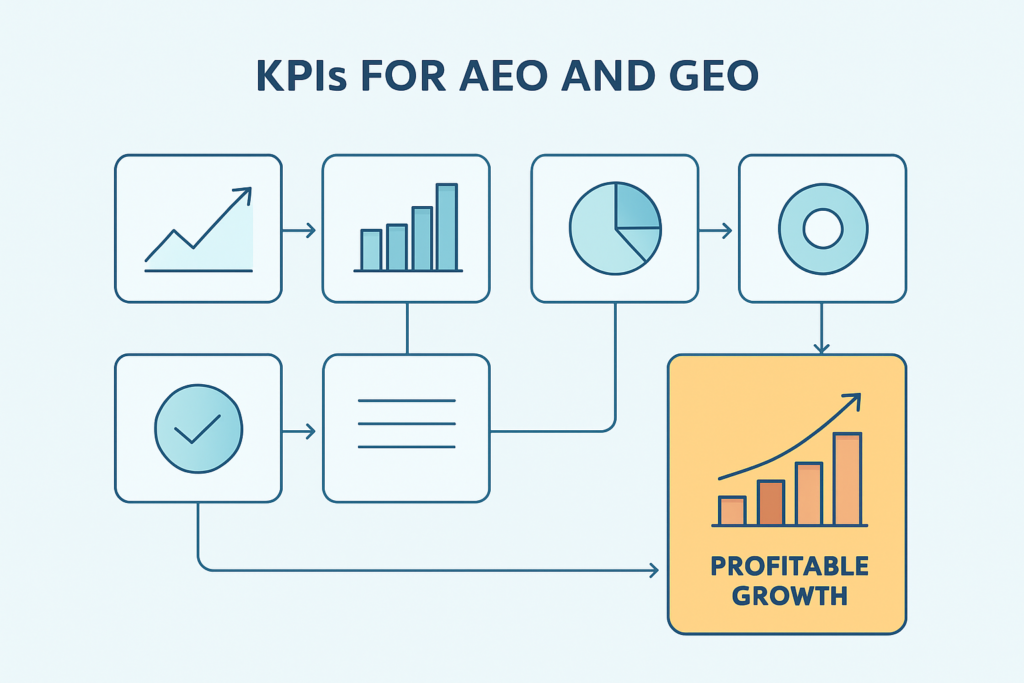

KPIs for AEO and GEO measure whether AI systems include, cite, recommend, and accurately represent your brand, then whether that exposure contributes to eCommerce revenue. Rankings and organic sessions still matter, but they cannot show the full commercial impact of a shopper who gets their answer inside an AI response.
For Shopify and WooCommerce teams, the reporting problem is practical: category demand can remain healthy while informational clicks soften, product comparisons move into answer engines, and attribution arrives incomplete. High-performing retailers keep SEO reporting intact, then add an AEO and GEO layer that measures discovery before the click.
The distinction between aeo and geo matters here. AEO tracks whether your content wins direct answers; GEO tracks whether generative systems choose your brand as a credible source or recommendation.
Core definition: KPIs for AEO and GEO measure how often AI engines include, cite, recommend, and accurately describe your brand in direct answers and AI-generated responses. The core metrics are AI visibility, Citation Rate, Share of Voice, sentiment and accuracy, and AI-influenced conversions or revenue.
Why Traditional SEO Reporting Misses Part of AI Search Performance
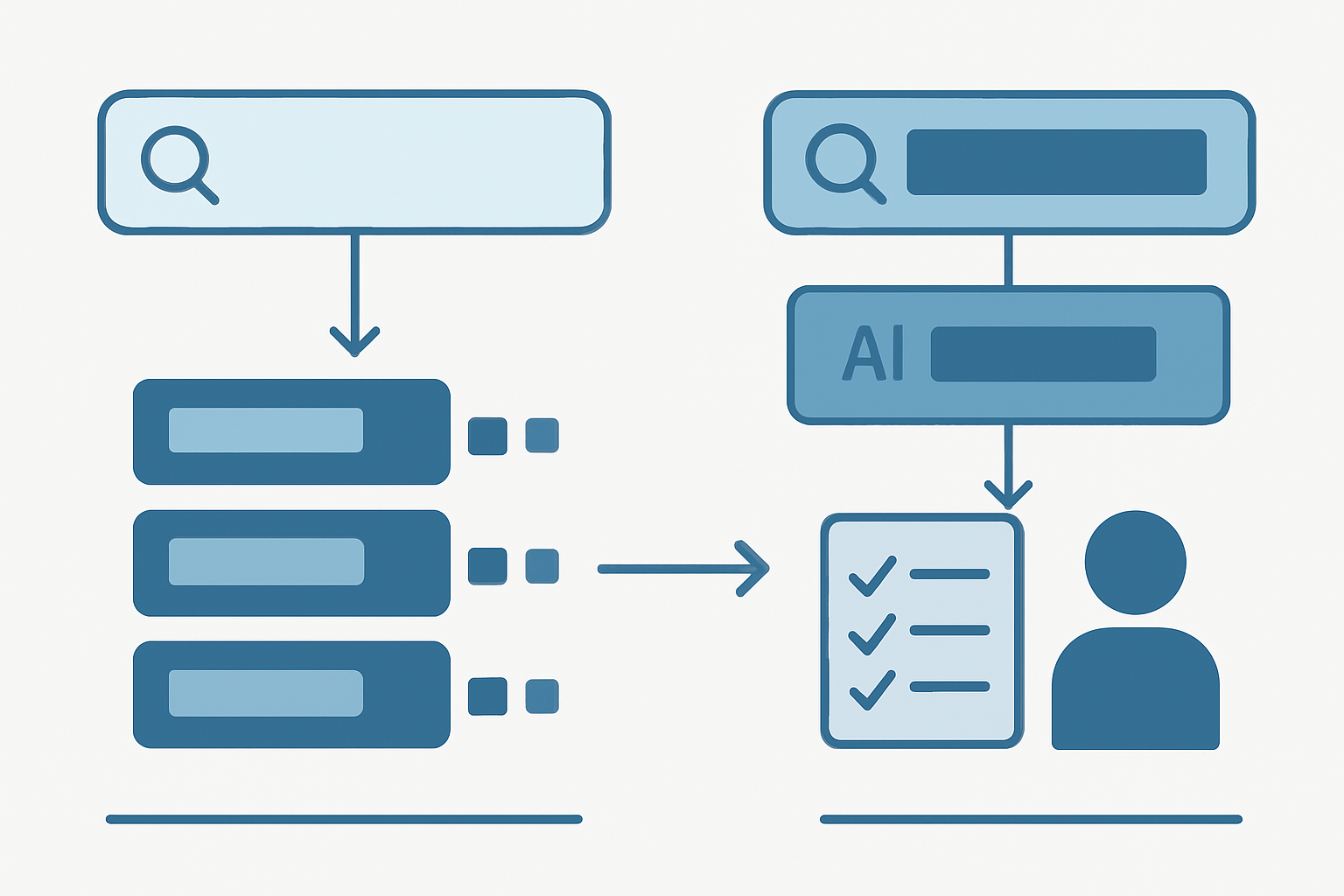
A stable ranking can coexist with fewer visits. When a shopper asks for the best trail-running hydration vest, compares materials, or checks sizing advice, an AI-generated answer can shape the shortlist before that shopper opens a blue link.
Traditional SEO remains the foundation. Search Console impressions, rankings, clicks, landing-page revenue, and technical health still reveal whether search engines can discover and rank your store. They simply do not measure every moment when an AI engine names your product, paraphrases your policy, or cites a buying guide without sending a measurable visit.
The click-through pressure is real. A reported CTR decline after AI Overview rollout illustrates why top-ranking pages cannot be evaluated on position alone when AI answer surfaces are present.
Organic traffic can decline while category demand remains healthy because shoppers are changing how they research. Use geo vs seo vs aeo as a reporting lens, including the geo vs seo distinction: separate lost click opportunity from lost brand visibility, then investigate the commercial consequence.
Shopify and WooCommerce retailers can use an SEO.DIGITAL technical and visibility audit to identify technical, content, and authority gaps that may be limiting discovery across search and AI systems.
SEO vs. AEO vs. GEO: What Each Measurement Layer Actually Tracks
Collapsing every visibility signal into one score hides the action required. SEO, AEO, and GEO share technical and content foundations, but each measures a different surface and buyer behavior.
| Measurement layer | Primary goal and surfaces | Core signals | Business outcome |
|---|---|---|---|
| SEO | Rank in traditional results | Rankings, impressions, clicks, organic revenue | Qualified site sessions and purchases |
| AEO | Win direct answers | Featured snippets, People Also Ask, answer inclusion | Earlier-stage buyer confidence |
| GEO | Appear in generative responses | Mentions, citations, recommendation prominence, sentiment | Influenced discovery, referrals, assisted revenue |
Google’s AI surfaces do not trigger evenly across every query. An analysis of when Google AI Overviews appear is useful context, but your own category, prompt set, and platform mix should determine what you measure.
The 7 KPIs for AEO and GEO That Matter Most
The best KPI set links leading indicators of AI visibility to lagging commercial outcomes. Do not treat a citation as revenue, and do not wait for perfect referral data before measuring whether your brand is present in high-intent conversations.
Use the seven metrics below as one system. The first five explain whether AI systems recognize and represent your store; the final two test whether that visibility is creating valuable customer behavior.
| KPI | Formula or measurement | Type | What an eCommerce team should do |
|---|---|---|---|
| AI visibility | Mentions ÷ tracked responses × 100 | Leading | Segment by engine, topic, and intent |
| Citation Rate | Qualifying citations ÷ tested prompts × 100 | Leading | Review cited page and citation prominence |
| AI Share of Voice | Brand citations or mentions ÷ total qualifying mentions × 100 | Leading | Compare against real category competitors |
| Prompt-level coverage | Prompts where brand appears, by segment | Leading | Find commercial topic gaps |
| Sentiment and entity accuracy | Accurate, positive, neutral, negative answer review | Leading | Correct misinformation and weak positioning |
| AI referral traffic and conversion rate | AI-referred sessions, purchases, and CVR | Lagging | Compare quality with other acquisition channels |
| Pipeline ROI and revenue contribution | (Attributed or assisted revenue − cost) ÷ cost | Lagging | Assess revenue, CAC, and investment efficiency |
1. AI Visibility and Answer Inclusion Rate
AI visibility is the percentage of tracked AI-generated responses where your brand appears at all. It is the first test of whether an AI engine associates your store with the category, use case, or buying question.
Formula: (responses mentioning brand ÷ total tracked responses) × 100
A mention is not automatically a win. Log whether the answer merely lists the brand, links to it, cites it as evidence, or explicitly recommends it. A retailer mentioned as one option among ten is not in the same position as the retailer presented first with a specific reason to buy.
Break results out by ChatGPT, Google AI Overviews, Gemini, Perplexity, Claude, and other relevant AI platforms. Then segment by informational, commercial, and transactional prompts. A blended average can conceal the fact that your brand owns post-purchase support questions but is absent from high-value comparison prompts.
2. Citation Rate and Citation Quality
Citation Rate measures the share of your fixed Prompt panel where an AI response cites your domain or clearly identifies your brand as a source. It is stronger than a generic mention because it signals that the system found a page useful enough to ground an answer.
Formula: (prompts with qualifying citation ÷ total prompts tested) × 100
Citation quality changes the interpretation. Record whether the citation appears in the answer body, sits among the first sources, supports a specific product claim, or is a low-prominence link after several competitors. Track the exact cited URL as well as domain totals.
A product page may earn citations for dimensions, while a category guide earns them for selection criteria. The cited-page list should drive content refreshes and internal-linking priorities, especially when you are building an example of content for aeo and geo around real buyer questions.
Do not use generic B2B Citation Rate benchmarks as retail targets. A niche furniture brand, a broad apparel retailer, and a specialist parts store face different prompt volumes, competitor sets, and answer behavior. Measure movement against your own baseline first.
3. AI Share of Voice Against Competitors
Share of Voice reveals your visibility relative to every brand that appears across the same Prompt panel. It answers the competitive question: when AI engines recommend products in this category, how often is your name in the answer compared with the alternatives?
Formula: (brand mentions or citations ÷ total qualifying brand mentions or citations) × 100
Build the competitor set from reality, not a legacy SEO spreadsheet. Include direct retailers, marketplaces, manufacturers, review publishers, and editorial sites that repeatedly shape recommendation answers.
A rising Share of Voice with flat referral traffic may still be valuable if your brand is entering consideration-stage answers. A rising share alongside poor sentiment, however, is a reputation issue rather than a growth signal.
4. Prompt-Level Coverage and Topic Gaps
Ad hoc prompting produces anecdotes. A fixed Prompt panel produces a trend line that can be reviewed, challenged, and improved.
Start with 20 to 40 buyer questions and group them into five practical segments:
- Category education: “What should I look for in a standing desk?”
- Product-use-case research: “Best standing desk for a small home office.”
- Comparisons and alternatives: “Brand A versus Brand B standing desk.”
- Buying criteria: Material, compatibility, price, durability, or sizing questions.
- Trust and post-purchase: Shipping, returns, care, warranty, and setup questions.
For each prompt, record absent, mentioned, cited, recommended, and inaccurate. The gaps where competitors are repeatedly recommended and your store is absent are usually more valuable than broad visibility averages.
Keep wording, location, device assumptions, platform, and competitor rules as consistent as possible within a reporting period. AI answers can vary, so the goal is disciplined directional measurement, not false precision.
5. Sentiment Analysis and Entity Accuracy
Visibility becomes a liability when the answer gets your business wrong. Retailers should measure not only positive, neutral, and negative language, but also whether AI engines accurately describe the products and policies that influence purchase confidence.
Review answers for four issues:
- Category position: Is the brand framed for the correct use case and customer?
- Product facts: Are materials, features, compatibility, and benefits correct?
- Commercial facts: Are pricing, availability, shipping, returns, and warranty details current?
- Recommendation quality: Is the brand recommended with a credible reason or dropped into a generic list?
Flag inaccuracies separately from sentiment. An answer that praises a product while inventing its sizing, stock availability, or return policy is not positive performance. It is a data-integrity issue that can create customer-service friction and lost trust.
6. AI Referral Traffic and Conversion Rate
AI referral traffic is the traffic that arrives through trackable links or citations from AI platforms. It is useful, but incomplete. Some AI-influenced journeys appear as direct traffic, branded search, or another source after the shopper leaves the answer interface.
In GA4, create a channel grouping for known AI referrers where available. Review sessions, engaged sessions, product views, add-to-cart rate, checkout initiation, purchase conversion rate, revenue per session, and returning-customer behavior against organic search and paid channels.
Treat direct-traffic shifts and branded-search lift as supporting evidence, not proof of causation. The strongest analysis combines referral data with prompt visibility, cited pages, and the timing of content or authority work.
7. Pipeline ROI, Revenue Contribution, and CAC Impact
For DTC retailers, Pipeline ROI translates to purchases, repeat revenue, and lower acquisition cost. For B2B eCommerce, wholesale, and high-consideration product lines, it can also include quote requests, account applications, and pipeline stages.
Formula: AI-adjusted ROI = (attributed or assisted revenue − program cost) ÷ program cost
Use a conservative methodology. Include directly measurable AI-referred revenue, then report assisted revenue separately rather than inflating last-click credit. Monitor whether high-intent AI traffic converts efficiently and whether stronger organic and AI discovery reduces paid-media dependence over time.
The board-level question is not “Did citations increase?” It is “Did better AI visibility create profitable demand at an acceptable cost?”
How to Measure AEO Performance Without Building a Vanity-Metric Dashboard
AEO performance is measured through direct-answer inclusion, featured-result visibility where available, prompt-level presence, citations or mentions, technical readiness, and downstream engagement. It should complement SEO metrics, not replace rankings, impressions, clicks, and organic revenue reporting.
Start simple. A spreadsheet, GA4, Search Console, and consistent manual or automated prompt checks are enough to establish a credible baseline before adding specialist platforms.
Step 1: Build a Fixed Prompt Panel Around Buyer Intent
Pull questions from site search, customer-service tickets, paid-search queries, sales conversations, reviews, and Search Console. Select 20 to 40 prompts that represent the products and categories you need to grow.
Include category terms, “best for” queries, comparisons, alternatives, product attributes, use cases, buying criteria, and trust questions. Keep the same panel stable for a full monthly reporting period so a shift in visibility reflects performance rather than a new question set.
Assign each prompt an intent label and a commercial priority. A prompt about cleaning instructions may matter for trust, while a “best [product] for [use case]” prompt may be a direct revenue opportunity.
Step 2: Record Results by Engine, Topic, and Competitor
For every prompt, record the engine, date, brand status, cited URL, recommendation position, competing brands, sentiment, and factual accuracy. Use a simple five-status taxonomy: absent, mentioned, cited, recommended, or inaccurate.
Do not rely on one blended average. Different AI engines retrieve different sources and may favor different publishers, retailers, or product data. That is why an aeo and geo report needs platform-level views before it rolls up to leadership.
Step 3: Connect AI Visibility to Shopify or WooCommerce Revenue Signals
Map AI-referred sessions to product-page views, add-to-cart events, checkout starts, purchases, revenue, and repeat purchases. Then compare conversion rate and revenue per session against organic search, paid social, paid search, and email.
Last-click reporting will understate AI influence. Use it for hard revenue evidence, then pair it with assisted-conversion windows, branded-search trends, and prompt coverage to form a cautious but commercially useful picture.
Qualified Shopify and WooCommerce brands can request an SEO.DIGITAL AI-search measurement roadmap to establish a baseline, priority Prompt panel, and revenue-focused KPI dashboard.
KPI Reporting Cadence: What to Review Weekly, Monthly, and Quarterly

Reporting frequency should match the decision being made. Daily score watching creates noise; quarterly-only reporting lets category and reputation issues sit too long.
- Weekly: Investigate sharp sentiment changes, technical accessibility problems, major launches, pricing or inventory changes, and material visibility losses.
- Monthly: Review AI visibility, Citation Rate, Share of Voice, prompt gaps, cited pages, and AI referral trends using the same prompt methodology.
- Quarterly: Assess assisted revenue, Pipeline ROI, CAC implications, content outcomes, digital PR impact, and the next strategic priority.
Hold the Prompt panel and measurement rules constant when comparing periods. LLM crawl logs can help diagnose whether crawlers reach key content, but crawling is not a primary KPI. A crawl does not guarantee a citation, a recommendation, or a purchase.
How to Optimize AEO and GEO Once the KPIs Reveal a Gap
Optimize AEO and GEO by improving the pages, brand signals, and technical foundations that make your store easier for AI and search systems to understand, trust, cite, and recommend. The action should follow the weak KPI, not a generic checklist.
Improve Low Visibility With Better Topic and Product-Use-Case Coverage
Low visibility usually points to a coverage or clarity gap. Create and refresh category guides, buying guides, comparison pages, product education, FAQs, and use-case content that answer the exact questions absent from your Prompt panel.
Make the page useful before making it “AI-friendly.” State who the product is for, what it solves, relevant trade-offs, specifications, compatibility, and next steps in clear sections. Helpful structure supports retrieval, but no heading or schema field guarantees a citation.
Improve Citation Rate With Technical Clarity and External Trust Signals
Low Citation Rate often reflects a trust architecture issue rather than a single page edit. Check crawlability, indexation, internal linking, product and category consistency, relevant structured data, and whether key claims are supported by genuinely useful resources.
Then strengthen third-party validation through quality links, digital PR, credible brand mentions, and authentic community participation. Schema and crawler access can help systems interpret your store, but neither forces AI citations.
For Shopify and WooCommerce retailers, technical audits, buyer-intent content, authority building, digital PR, and genuine community signals work best as connected inputs. That is the difference between short-lived prompt tactics and durable category authority.
Improve Sentiment and Recommendation Quality With Consistent Brand Facts
Fix the source material before trying to influence the answer. Audit product descriptions, policy pages, comparison claims, FAQ content, merchant information, and public brand mentions for contradictions or stale details.
Do not manufacture reviews or spam forums. Publish accurate facts, resolve real customer issues, and maintain consistent messaging across the places customers and AI systems can encounter your brand. Better recommendation quality follows credible evidence.
A Simple AEO/GEO Dashboard for eCommerce Leaders
A leadership dashboard should answer three things quickly: are we more visible, are we represented accurately, and is that visibility producing valuable customer behavior? Keep detailed prompt logs in a working view and surface only decisions in the executive view.
Create separate dashboard views by AI platform and intent segment. For each of the seven metrics, include:
- Current and prior value: Report the current period beside the prior comparable period.
- Source and formula: Identify the Prompt panel, GA4 channel group, CRM, or commerce data used.
- Owner and insight: Name the accountable team and the likely reason for movement.
- Next action: Tie the metric to a page refresh, technical fix, PR initiative, or measurement check.
- Data-quality flag: Mark results affected by changing prompts, incomplete referrers, or inaccurate AI output.
A dashboard design framework can help with structure, but do not overreact to an isolated score. A visibility gain without commercial relevance, accurate positioning, or conversion-ready landing pages is not a strategy win.
Frequently Asked Questions About KPIs for AEO and GEO
What Are the 5 Main KPIs?
The five foundational GEO KPIs are AI visibility or answer inclusion, Citation Rate, Share of Voice, sentiment and entity accuracy, and AI-influenced traffic, conversions, or revenue. Prompt-level coverage is the operational layer that makes the first three metrics actionable.
How Do You Measure AEO Performance?
Measure AEO performance through direct-answer inclusion, featured-result visibility where available, prompt-level presence, citations or mentions, content and technical readiness, and downstream traffic or conversions. It expands traditional SEO reporting rather than replacing it.
What Are 5 Key Performance Indicator Examples?
For eCommerce, examples include visibility for “best” category prompts, Citation Rate for product guides, Share of Voice against direct competitors, accurate sentiment around product benefits, and conversion rate or revenue from AI referral traffic. Each should be reviewed by platform and prompt intent.
How Do You Optimize AEO and GEO?
Establish a baseline, identify prompt and topic gaps, improve content clarity and technical accessibility, strengthen entity consistency and third-party trust, then track business impact over consistent periods. Focus effort on high-intent buyer questions, not generic mention volume.
Turn AI Visibility Into Profitable eCommerce Growth
The goal is not a vanity score or more mentions for their own sake. The goal is to become the trustworthy, accurately represented retailer that AI systems and search engines surface when high-intent shoppers research products.
SEO.DIGITAL helps Shopify and WooCommerce stores connect technical health, buyer-intent content, authority building, digital PR, authentic community signals, and transparent revenue-focused reporting. That work creates a stronger basis for AI visibility while reducing reliance on increasingly expensive paid acquisition.
If your Shopify or WooCommerce brand generates $50k+ MRR, [book a call] for a no-obligation deep-dive consultation covering AI-search visibility gaps, technical health, high-intent content opportunities, and a custom organic growth roadmap.