
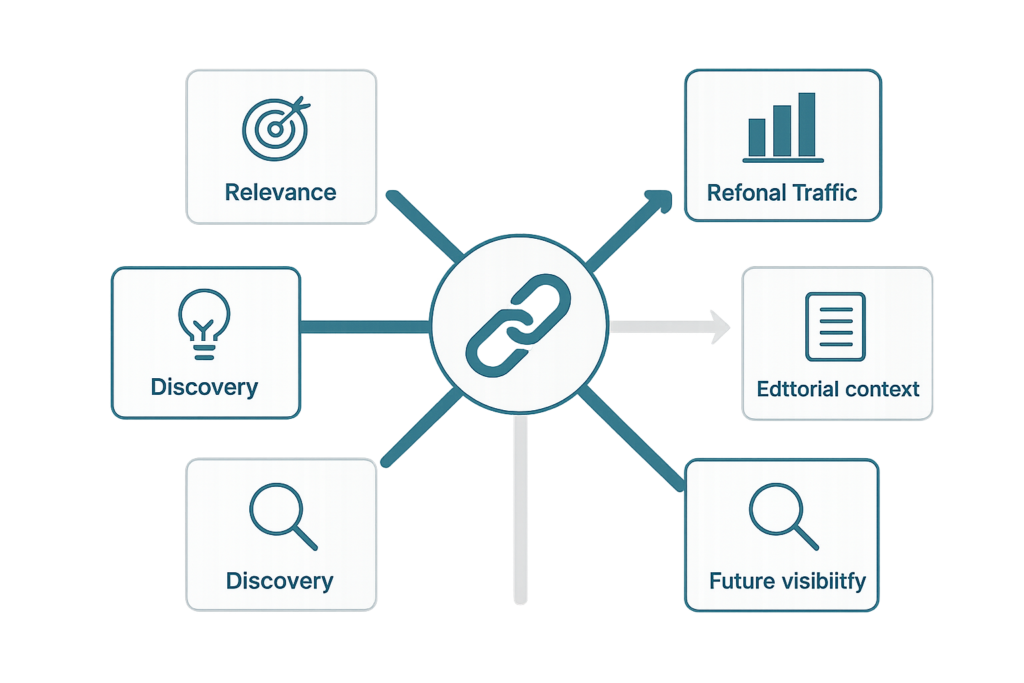

A nofollow placement can be a wasted line item or a profitable source of shoppers, brand discovery, and future editorial mentions. The difference is not the attribute alone. Nofollow links seo value depends on where the link appears, who sees it, what page it supports, and whether that attention contributes to real commercial outcomes.
The old view treated every nofollow link as a dead end for SEO. High-performing eCommerce teams take a broader view: they protect compliance, pursue credible visibility, and measure qualified visits, assisted revenue, and earned follow-on coverage.
Nofollow Links SEO Value: The Short Answer

Nofollow links can have SEO value, but it is conditional and often indirect. Google may treat rel="nofollow" as a hint when interpreting links, yet no individual nofollow link is guaranteed to pass PageRank or improve a Google ranking.
That does not make the placement irrelevant. A relevant mention can send shoppers to a collection page, expose a useful resource to writers, help search engines discover content, and make a backlink profile reflect genuine PR, community, and editorial activity. A reported clarification on Google’s treatment of useful nofollow links reinforces why the blanket “zero value” verdict no longer holds up.
The practical rule: assess the opportunity, not just the attribute
A nofollow link from a trusted trade publication read by your buyers can outperform a dofollow link dropped on an irrelevant, low-quality site. High-quality links earn their value through relevance, placement, audience trust, referral traffic, and commercial fit.
For link building decisions, ask whether the placement would still be worthwhile if search engines ignored it entirely. If it can introduce a category page, buying guide, or product to people likely to act, it deserves serious consideration.
Teams still debating whether do nofollow links help SEO often frame the issue too narrowly. The better question is whether the opportunity creates credible visibility that can compound through traffic, mentions, and future links.
What Is a Nofollow Link?
A nofollow link is a hyperlink with a rel="nofollow" attribute. It tells search engines that the publisher is qualifying the relationship with the destination rather than offering an unqualified endorsement for ranking purposes.
<a href="https://example.com" rel="nofollow">Example link</a>
The rel attribute sits inside the HTML anchor tag. Visitors can still click the link normally, land on the destination, browse products, and convert. The qualification affects how search engines may interpret the link, not the user experience.
This is separate from a page-level meta robots instruction and separate again from robots.txt. A nofollow attribute qualifies one outbound link; it does not block a page from indexing or control a whole site’s crawl behavior.
Nofollow vs. dofollow links
“Dofollow” is industry shorthand, not a formal HTML attribute. In practice, it describes an ordinary link with no qualifying rel value, which may contribute link equity, sometimes called link juice, to the linked page.
Nofollow links qualify that relationship. They may be considered as hints, while standard followed links have clearer potential to contribute to ranking systems. Neither label predicts the total commercial value of a placement.
| Link type | Typical HTML | What it communicates | What to evaluate |
|---|---|---|---|
| Followed link | <a href="..."> |
No specific qualification | Editorial relevance, source quality, destination fit |
| Nofollow link | rel="nofollow" |
General qualified relationship | Visibility, referral traffic, discovery, context |
| Sponsored link | rel="sponsored" |
Paid or compensated relationship | Disclosure, compliance, audience value |
| UGC link | rel="ugc" |
User-generated content | Moderation, authenticity, spam risk |
How to check whether a link is nofollow
Verification takes less than a minute:
- Right-click the link and choose Inspect or Developer Tools.
- Find the anchor tag that starts with
<a href=. - Check the rel value for
nofollow,sponsored,ugc, or a combination.
This confirms the link attributes in the HTML. It cannot reveal exactly how Google weighs that link among its many ranking signals. For site owners managing large volumes of outbound links, the WordPress external-link management plugin documentation shows one way to apply settings consistently.
How Google’s Treatment of Nofollow Links Changed
Legacy advice persists because nofollow began as an anti-spam mechanism. In 2005, it gave publishers a way to discourage comment spam by signaling that links in untrusted contexts should not receive ranking credit.
The original explanation was much stricter: nofollow links would not get ranking credit. That history still explains the attribute’s purpose, but it does not fully describe the current model.
The important timeline is simple:
- 2005: Nofollow emerged to combat comment spam and unvetted links.
- 2019: Google announced
sponsoredandugcattributes and said link qualifiers would be treated as hints. - 2020 onward: Hint-based treatment extended to crawling and indexing decisions as well as ranking-related analysis.
Search engines do not publish a reliable percentage of value for any nofollow link. Treat claims about fixed PageRank transfer, automatic lifts, or universal follow-to-nofollow ratios as speculation, not operating guidance.
From strict directive to ranking hint
Hint-based treatment gives search engines more context than a rigid binary rule. A nofollow link may be considered alongside relevance, placement, source signals, spam patterns, and other information, but that does not guarantee ranking credit.
The change matters because it shifts the conversation from “does this link pass value?” to “what evidence does this placement provide, and what measurable outcomes does it create?” This explanation of why Google changed nofollow to a hint provides useful background on that shift.
Why the old “nofollow equals zero” answer is incomplete
The old answer ignores both the hint model and the business value that exists outside direct ranking calculations. A nofollow citation can be seen by journalists, creators, customers, and industry peers who later make independent editorial decisions.
It also ignores discovery. Search systems can find URLs through multiple routes, and a useful nofollow mention may put a strong resource in front of people who can amplify it. None of this means every nofollow link passes link equity. It means the attribute is not a complete valuation model.
Where Nofollow Links Create SEO Value
The strongest nofollow placements produce outcomes you can observe. Direct algorithmic consideration may be possible but uncertain; business value can be measured through analytics, conversion paths, and subsequent coverage.
Use this distinction when reporting results to a founder or marketing director. It prevents a link report from becoming a count of attributes with no connection to revenue.
| Potential search value | Measurable business value |
|---|---|
| Search engines may use the link as a contextual hint | Qualified referral sessions to a category, product, or guide |
| Content or URL discovery may improve | Engaged sessions, email signups, and direct conversions |
| Exposure can support future earned editorial links | Assisted conversions and attributable revenue |
| A naturally varied backlink profile provides context | Branded-search growth and new referring domains |
Relevant referral traffic can become revenue
A nofollow link in a specialist product review, retailer roundup, or respected community thread can put a buyer in front of the right destination immediately. Send that visitor to the page that matches the mention: a collection, product comparison, buying guide, or category page, not automatically the homepage.
Measure referral sessions, engaged sessions, conversion rate, direct conversions, assisted conversions, and revenue. A referral source should be judged by engaged visits and conversion contribution, not raw session volume.
The same attribution discipline helps answer do outbound links help SEO when teams evaluate the full visibility and user-value picture, rather than treating a link as an isolated ranking lever.
SEO.DIGITAL helps qualified Shopify and WooCommerce brands assess PR mentions, creator placements, community conversations, and niche publications against qualified traffic, conversion, and revenue goals rather than link counts alone.
Brand visibility and discovery can lead to earned links
A credible nofollow mention can create a second-order opportunity. A journalist may find your original research, a creator may reference a useful guide, or a buyer may share a product comparison with their audience.
That outcome is never guaranteed. It becomes more likely when the linked asset contains original data, clear expertise, or a genuinely useful point of view worth citing.
A diverse backlink profile provides context
Authentic authority-building activity creates a mix of editorial links, social mentions, community references, reviews, citations, and PR coverage. Those sources will not all use the same attribute, and they should not.
There is no universal safe nofollow-to-dofollow ratio supplied by Google. Third-party metrics such as Domain Authority can help compare sites, but they are not Google ranking metrics and should never replace an assessment of relevance, readership, and editorial quality.
When publishers ask about nofollow external links, the answer should begin with transparency and context. Qualify the relationship accurately, then focus on whether the resource improves the reader’s experience.
Nofollow, Sponsored, and UGC: Which Attribute Should You Use?

Correct link qualification protects publisher trust and helps search engines understand why an outbound link exists. The right attribute depends on the relationship behind the placement, not the outcome you hope to achieve.
Use this quick decision path:
- Was there compensation? Use
rel="sponsored"for advertising, affiliates, sponsorships, paid posts, or product compensation. - Was it submitted by users? Use
rel="ugc"for comments, forums, reviews, and community contributions. - Is a general qualifier appropriate? Use
rel="nofollow"when you do not want to provide an unqualified endorsement. - Is it an editorial citation? A normal followed link may be appropriate when it is genuinely earned and relevant.
Use rel=”sponsored” for paid and affiliate relationships
Compensation is broader than a cash payment. Free products, services, commissions, sponsorship value, and negotiated promotional consideration can all create a commercial relationship that requires clear qualification.
Use rel="sponsored" for affiliate links and paid placements. This is not a reason to reject legitimate partnerships. It is a reason to run them transparently and avoid paid-link arrangements masquerading as independent editorial recommendations.
Use rel=”ugc” for comments, forums, and community submissions
Comments and forums are valuable places for genuine product expertise and buyer support. They are also common targets for automated promotion, which is why user-generated content needs sensible qualification and moderation.
Useful participation answers a real question, adds evidence, and links only where the destination materially helps the reader. Thin forum drops, copied answers, and promotional comment spam create no durable authority and can damage brand credibility.
How to Evaluate a Nofollow Link Opportunity for an eCommerce Brand
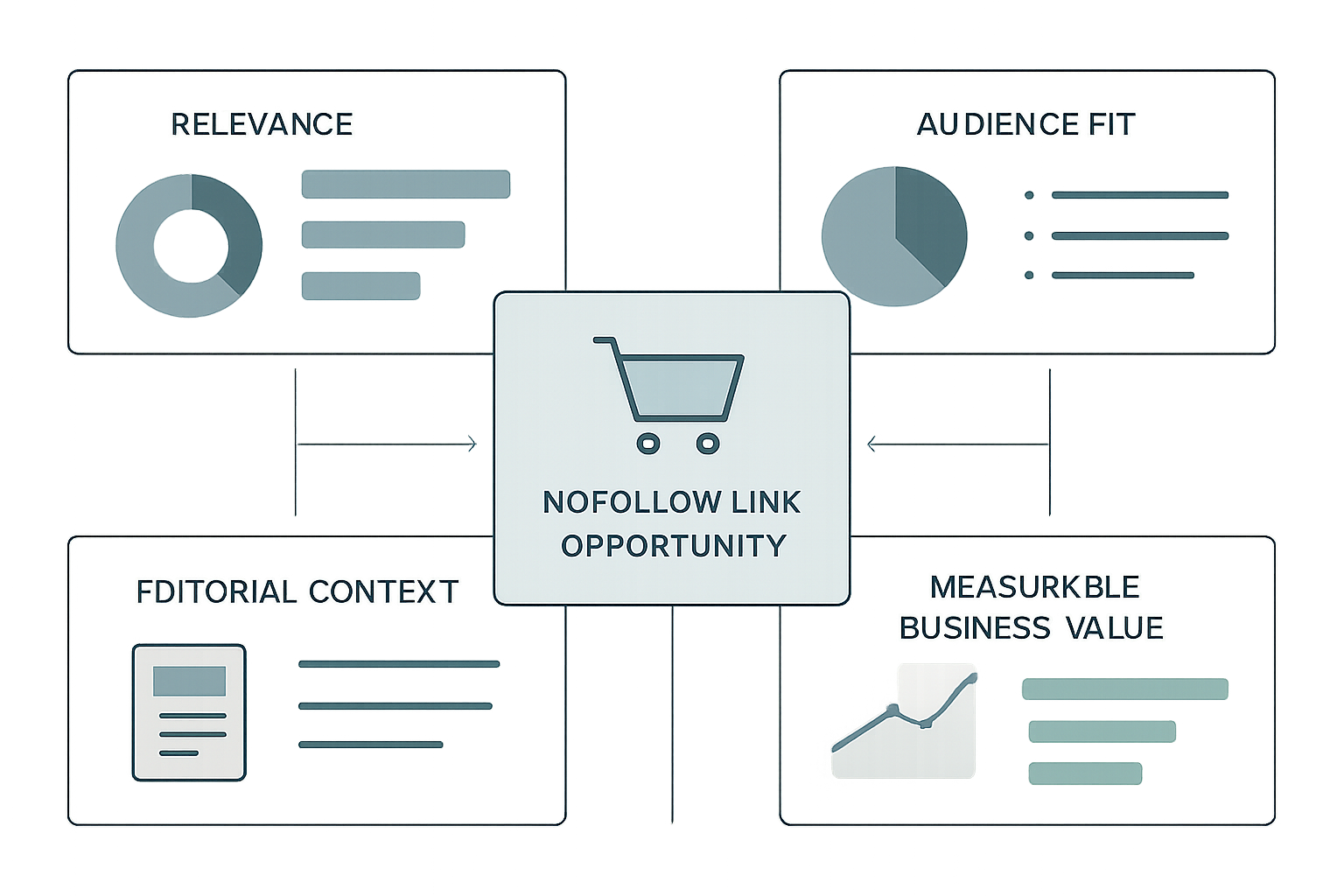
A nofollow link deserves budget only when it can contribute to a revenue-focused authority strategy. Treat the opportunity like a channel decision, not a checkbox in a backlink report.
Score each placement before committing time, inventory, product samples, or PR budget:
- Relevance: Does the publication, creator, or community serve your category and buyer?
- Audience fit: Can it reach people with a credible reason to visit and purchase?
- Editorial context: Is the mention useful, visible, and surrounded by relevant content?
- Landing-page fit: Does the destination match the reader’s intent and convert well?
- Compliance and measurement: Is the relationship properly qualified, brand-safe, and trackable?
Authority-growth review: If your Shopify or WooCommerce store generates $50k+ MRR and needs a clearer authority-growth plan, SEO.DIGITAL can assess your backlink profile, content opportunities, digital PR potential, and technical SEO foundation.
Prioritize relevance, audience fit, and editorial context
A niche mention with an engaged audience is usually more valuable than a generic placement on a site with impressive-looking metrics but no buyer overlap. For a cycling retailer, a feature in a respected cycling resource can create meaningful referral traffic even when the link is nofollow.
The destination page should match the reader’s intent rather than merely collect a backlink. A comparison article should point to a comparison page; a seasonal product feature should point to the relevant collection; a research citation should point to the original research.
Teams asking are nofollow links good for SEO should assess the full path from placement to page to conversion. That is where the commercial truth sits.
Reject spammy shortcuts and low-value placement schemes
Mass comment submissions, irrelevant forum links, low-grade directory packages, and paid-link schemes do not become strategic because a report shows more referring domains. They usually lack audience value, editorial substance, and a legitimate reason to exist.
Do not manufacture “natural noise.” Earn legitimate attention through useful assets, credible PR relationships, expert community contribution, and content that answers a buyer’s real question.
Measure outcomes beyond link counts
Track what changed after a placement goes live: referral sessions, engaged sessions, conversion rate, assisted conversions, direct revenue, branded-search interest, new referring domains, and organic traffic to the linked landing page.
Ranking movement over time is worth monitoring, but attribution has limits. A positive change does not prove one nofollow link caused it. It does show whether your combined content, technical, PR, and authority work is moving in the right direction.
Common Nofollow Link Myths to Stop Believing
False binaries make bad link decisions. The following claims are common because they are easy to repeat, not because they reflect how search engines and real customers behave.
Myth: Nofollow links are worthless
Reality: A nofollow link may provide little or no direct ranking impact in one situation and still generate qualified referral traffic, brand awareness, discovery, and future earned mentions. Evaluate total business value, not the attribute in isolation.
A respected publication that sends high-intent visitors can be more valuable than a weak dofollow placement that no real buyer sees.
Myth: Every nofollow link improves rankings
Reality: Hint-based treatment does not create a ranking promise. Google may consider a nofollow link among many signals, but no one can responsibly guarantee PageRank transfer, a ranking lift, or a timeline.
Reported tests and individual case studies can be interesting evidence. They are not a substitute for a repeatable strategy built on relevance, technical quality, useful content, and credible authority.
Myth: You need a fixed nofollow-to-dofollow ratio
Reality: No universal ratio has been provided by Google. Fixed percentages confuse a naturally earned backlink profile with a formula that can be manufactured.
Aim for authentic acquisition patterns. If your activity includes earned editorial coverage, product reviews, partnerships, community discussion, and useful resources, a varied profile is the expected result.
FAQ: Nofollow Links and SEO Value
Are nofollow links good for SEO?
Nofollow links can be good for SEO and business performance when they are relevant, visible to the right audience, and part of legitimate authority-building activity. They can drive referral traffic, discovery, and future earned mentions, but they do not guarantee direct ranking credit.
What is the 80/20 rule in SEO?
There is no nofollow-specific 80/20 formula that tells you how many followed or nofollow links to acquire. Apply the principle to effort: prioritize the smaller set of technical, content, PR, and link-building activities most likely to increase qualified traffic, revenue, and durable authority.
Which type of link is most valuable for SEO?
A contextually relevant, editorially earned link from a trusted source that reaches the right audience is generally the strongest type of placement. Followed links may have greater direct link-equity potential, but a high-quality nofollow link can still create significant commercial and indirect SEO value.
Do follow nofollow in SEO?
“Dofollow” usually means a normal link without a qualifying rel attribute. A nofollow link uses rel="nofollow", while rel="sponsored" is for paid relationships and rel="ugc" is for user-generated content.
Final Takeaway: Treat Nofollow Links as Strategic Visibility, Not a Shortcut
Nofollow links are neither worthless nor guaranteed ranking assets. Their SEO value comes from the total opportunity: trustworthy visibility, relevant referral traffic, useful discovery, credible context, compliant publishing, and the possibility of future earned attention.
The durable approach combines technical SEO, buyer-focused content, credible digital PR, authentic community participation, and high-quality link acquisition. It rejects shortcut schemes and measures results in qualified traffic and revenue, not vanity counts.
If you run a Shopify or WooCommerce brand generating $50k+ MRR, book a call with SEO.DIGITAL for a no-obligation deep-dive consultation. We will review your technical SEO, content, authority building, digital PR, community signals, and revenue-focused organic-growth opportunities to build a transparent roadmap.