


Product content breaks down long before a shopper reaches checkout. The usual culprit is not weak writing. It is the absence of a product content strategy that connects what buyers need to know with what your store publishes, ranks for, and measures.
For Shopify and WooCommerce brands, product content is commercial infrastructure. It shapes discovery in search, confidence on category and product pages, conversion at checkout, and customer satisfaction after the order arrives.
The old approach treats content as a production queue: write descriptions, publish a few articles, fill the calendar, then hope traffic follows. High-performing content teams run a governed system where every asset has a customer need, commercial purpose, accountable owner, and review date.
What Is a Product Content Strategy?
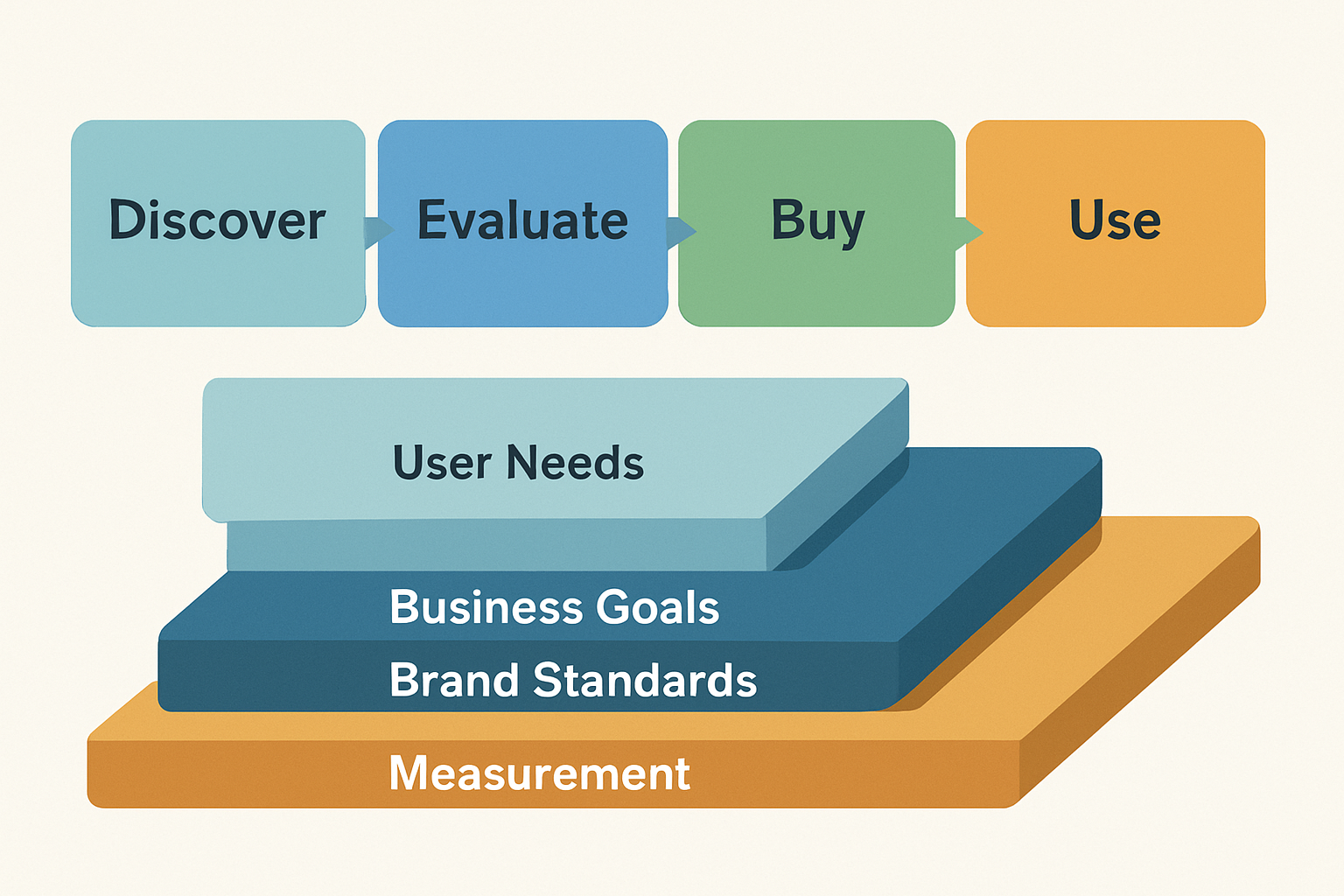
A product content strategy is a documented plan for creating, organizing, publishing, measuring, and maintaining the content that helps customers discover, understand, evaluate, buy, and use a product. It aligns product information with user needs, business goals, brand standards, and measurable outcomes.
That scope matters. This is not just product-page copy. For an eCommerce business, it covers collection pages, buying guides, comparison pages, FAQs, email flows, shipping and returns guidance, reviews, setup resources, and post-purchase education.
A strong strategy also accounts for the full content lifecycle. Your team needs a process to create and approve assets, but it also needs rules for updating changing specifications, consolidating overlapping pages, redirecting retired URLs, and removing information that is no longer accurate.
Product Content Strategy vs. Content Marketing Strategy
Content marketing attracts and nurtures an audience. It often includes editorial content, social distribution, email, partnerships, and campaigns designed to earn attention before a person is ready to buy.
Product content strategy governs the experience around the product itself. It answers what the product is, who it is for, how it compares, what it costs, what happens after purchase, and where a shopper can get help.
The distinction is practical, not academic. A buying guide may bring in non-branded search traffic, but if it uses different terminology than the collection page, does not link naturally to relevant products, or leaves major objections unresolved, it will not do its commercial job.
| Strategic decision | Product content strategy | Tactics that execute it |
|---|---|---|
| Purpose and audience | Defines the buyer need, business goal, journey stage, owner, and KPI | Product descriptions, guides, FAQs, emails, videos |
| Message architecture | Sets claims, terminology, proof points, and voice rules | Headlines, comparison charts, CTA copy, support articles |
| Experience design | Connects content across search, pages, purchase, and support | Internal links, navigation labels, page modules, email flows |
| Governance and measurement | Defines review cycles, approvals, and success criteria | Content calendar, briefs, reports, testing, refreshes |
Content marketing and product content should reinforce each other. The first earns the right audience’s attention. The second makes it easier for that audience to make a confident purchase.
Why Product Content Cannot Be an Afterthought
Late-stage content creates expensive rework. Design is finalized around placeholder text, merchandising launches products with incomplete detail, and SEO is asked to add keywords after the page structure is fixed.
The shopper sees the result immediately: vague value propositions, inconsistent terminology, missing compatibility information, and unclear reasons to choose one product over another. Your support team sees it later through repetitive tickets and return-related questions.
Small wording changes can affect behavior when they remove friction at the right moment. A Monzo push-notification example reported that adding the prompt “Tap to say thanks!” increased engagement from roughly 5% to around 50%. The lesson is not to chase clever microcopy. It is to treat content as part of the customer action, not decoration added after the experience is built.
The 5 Pillars of a Product Content Strategy
A revenue-connected product content strategy has five working parts. Miss one, and the system becomes fragile: strong content without ownership gets stale; traffic without a commercial purpose becomes a vanity metric; brand language without buyer research becomes internal jargon.
Pillar 1: Business Purpose and Content Goals
Start with the business problem, not the asset format. “We need more blog posts” is a request. “We need to increase qualified organic sessions and revenue from our highest-margin collection” is a strategic objective.
Assign one primary outcome to each major initiative. A category guide may aim to win non-branded discovery. A revised product template may aim to improve add-to-cart rate. A sizing FAQ may aim to reduce support friction and returns.
Useful objectives include:
- Grow category visibility for high-margin, non-branded searches.
- Resolve buyer objections around fit, materials, compatibility, or price.
- Improve conversion efficiency on products with traffic but weak add-to-cart rates.
- Support retention through care, setup, replenishment, and usage guidance.
- Lower acquisition costs by shifting qualified demand from paid channels to organic discovery.
Set supporting KPIs before production begins. For example, a category-page initiative could track impressions, ranking growth, qualified sessions, assisted revenue, and direct organic revenue. That produces better decisions than celebrating traffic that never reaches a product page.
Pillar 2: Target Audience and Customer Journey
Your customers already explain what content is missing. The evidence is sitting in support tickets, onsite search logs, product reviews, return reasons, sales conversations, survey responses, and the phrases people use in search.
Do not rely solely on internal assumptions about why people buy. Merchandisers may know the product range deeply, but customers often describe their problem, desired outcome, and purchase barrier in very different language.
Use UX research methods for understanding customer needs to structure interviews, usability observation, and surveys around actual decisions. Ask customers what nearly stopped them from buying, what they compared, which terms confused them, and what they needed after delivery.
Then map those insights across the journey:
- Discovery: The shopper recognizes a problem or explores a category.
- Evaluation: They compare materials, features, price points, and alternatives.
- Decision: They need reassurance about fit, delivery, returns, proof, and product suitability.
- Use: They need setup, care, troubleshooting, or usage guidance.
- Retention: They need replenishment prompts, complementary products, and reasons to return.
Customer language should feed both SEO research and conversion copy. That connection is where content strategy and seo stop being separate workstreams and become one commercial system.
Pillar 3: Product Information, Messaging, and Content Types
Every product asset should have a job. If a page cannot state the buyer it serves, the question it answers, its source of truth, and the metric it influences, it is probably publishing noise.
Your core product-information system usually includes product descriptions, collection copy, comparison pages, buying guides, product FAQs, use-case pages, email education, shipping and returns content, and support resources. Each asset needs a role in the journey and consistent terminology across connected touchpoints.
Information hierarchy is where many stores lose shoppers. The most decision-critical details, such as compatibility, sizing, ingredients, care requirements, delivery constraints, or return eligibility, should not be buried under brand storytelling. Learn how to structure information for findability before asking shoppers to hunt through tabs, accordions, and dense prose.
A practical message architecture answers four questions:
- What it is: The product category, core function, and fit.
- Why it matters: The outcome or problem it solves.
- Why trust it: Evidence, material detail, reviews, credentials, or proof.
- What to do next: The clearest relevant action, whether that is comparing, selecting, purchasing, or learning more.
This is also where brand voice earns its keep. Tone should make product information easier to understand, not conceal it behind clever phrasing. A premium brand can sound distinctive while still stating dimensions, limitations, delivery terms, and care instructions plainly.
Pillar 4: Governance, Workflow, and Ownership
Content becomes inaccurate when nobody owns the change. A new ingredient, revised sizing chart, discontinued product, policy update, or changed fulfillment promise can create conflicting information across a store in hours.
Define ownership at the operational level. Your workflow should identify who requests work, supplies product facts, researches demand, writes, reviews for SEO and brand standards, approves claims, publishes, measures, updates, and retires content.
A workable eCommerce model often looks like this:
- Merchandising or product owns factual product inputs and range priorities.
- Content lead or writer owns briefs, drafting, and editorial consistency.
- SEO lead owns search opportunity, internal discoverability, and indexation requirements.
- Design and development own template implementation and component behavior.
- Support and legal validate customer friction, policies, safety, and regulated claims.
Your content calendar belongs here, after strategy. It should show the asset, target buyer, journey stage, page type, keyword opportunity, owner, reviewer, launch date, distribution plan, and review window.
Pillar 5: Measurement, Maintenance, and Optimization
Publication is a starting line. Product information changes, search demand shifts, category competitors improve, and customer questions evolve. A content strategy process without maintenance is a short-term campaign disguised as a system.
Review page performance against the job assigned to that page. Category pages should earn relevant discovery and revenue. Product pages should help shoppers add to cart and purchase. Post-purchase content should reduce avoidable support work, returns, and dissatisfaction.
Use ways to test whether website content supports user tasks when metrics flag possible friction. Analytics can show a low conversion rate or an exit pattern. Testing and qualitative review reveal whether shoppers could not find a sizing detail, misunderstood a claim, or failed to see the path from guide to product.
How to Create a Product Content Strategy in 7 Steps
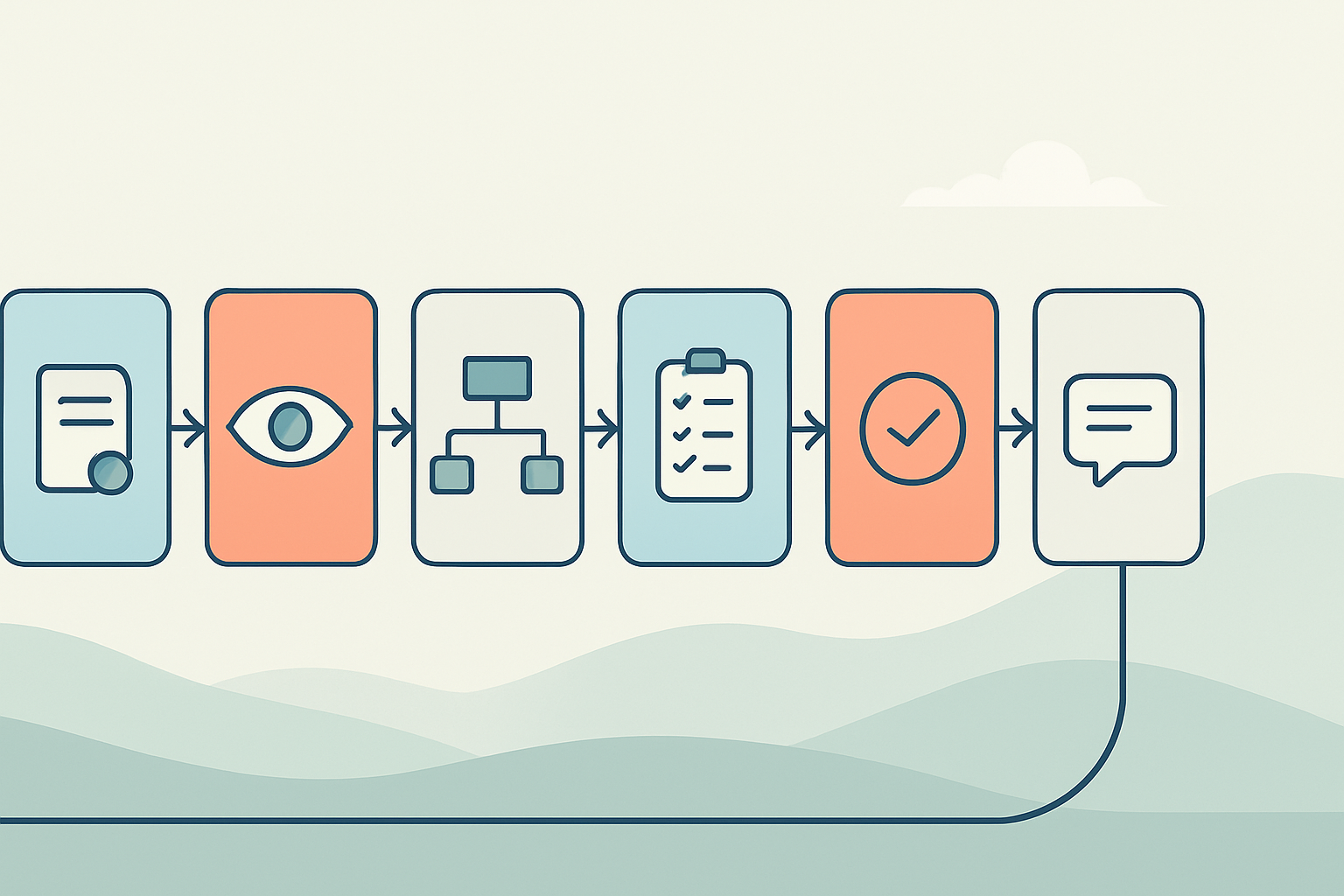
The fastest route to wasted budget is producing new assets before you understand the weaknesses in the existing system. Build your product content strategy in this order so each decision has evidence behind it.
Step 1: Audit Your Existing Product Content
Inventory product pages, collections, buying guides, blog posts, FAQs, campaign landing pages, email flows, and support resources. Record the URL, content type, product or category priority, traffic, conversion contribution, accuracy, owner, last review date, and current decision.
For each asset, choose one action: keep, update, consolidate, redirect, remove, or create. Do not treat content volume as an achievement. Thin, duplicative, outdated, or unowned content can dilute both shopper confidence and search visibility.
Audit duplicate product copy carefully. A clear seo duplicate content product pages process helps stores identify overlapping variants, stale collections, and conflicting category information before those pages compete with each other or confuse crawlers.
Step 2: Define Revenue-Focused Business Goals
Pick objectives that reflect the commercial pressure your business is under. A store spending heavily on paid acquisition may prioritize non-branded category visibility. A product line with strong traffic but weak conversion may need better comparison content, proof points, and objection handling.
Write goals with a defined result and measurement period. For example: improve organic revenue from a priority collection, lift add-to-cart rate for a weak product range, reduce sizing-related support contacts, or increase repeat purchase through better usage education.
Keep the goal specific enough to force tradeoffs. “Increase awareness” does not tell a team what to publish, what to improve, or how to judge success.
Step 3: Research Your Target Audience and Buying Barriers
Purchase barriers are content opportunities with commercial consequences. Shoppers may hesitate over fit, material quality, compatibility, ingredients, delivery timing, maintenance, price justification, alternatives, or returns.
Pull those barriers from reviews, support logs, return codes, survey answers, site-search terms, and sales calls. Look for repeated questions and the language customers use before they are familiar with your internal product names.
Separate evidence from opinion. If the product team thinks “premium construction” is the main selling point but reviews repeatedly celebrate “easy to clean,” your priority messaging may need to change.
Step 4: Map Content to the Customer Journey
A shopper should not feel like they have entered a different business when moving from a search result to a guide, category page, product page, email, or support article. Consistent language and expectations reduce hesitation.
Map content needs by stage:
| Journey stage | Buyer need | Recommended content | Primary signal |
|---|---|---|---|
| Discovery | Understand the problem or category | Educational guide, use-case content, category introduction | Qualified non-branded traffic |
| Evaluation | Compare options and assess fit | Comparison page, buying guide, collection filters | Product-page clicks and assisted revenue |
| Decision | Resolve final objections | Product page, FAQs, reviews, shipping and returns detail | Add-to-cart rate and conversion rate |
| Post-purchase | Set up, use, and maintain the product | Setup guide, care content, support email | Return reduction and task completion |
| Retention | Find complementary or repeat products | Replenishment email, use-case guide, related products | Repeat purchase and LTV |
The connection between discovery and decision is especially important. Your seo content strategy should direct informational pages toward relevant commercial next steps without forcing a sales pitch before the shopper is ready.
Step 5: Define Messaging, Voice and Tone, and Content Guidelines
Inconsistent terminology quietly damages conversion. A shopper who sees one material name in an ad, another on a category page, and a third in the product specification may question whether they are looking at the same item.
Document standards for product naming, message hierarchy, approved claims, proof requirements, reading level, formatting rules, words to avoid, and channel-specific tone. Include rules for product details that create legal, safety, or returns risk.
Clarity must win when the stakes are high. Product specifications, compatibility details, delivery promises, returns information, and calls to action should be direct enough to prevent misinterpretation.
Step 6: Build the Content Creation Process and Calendar
A calendar cannot repair disconnected teams. When SEO, merchandising, product, and editorial work from separate priorities, your team publishes assets that compete for attention, repeat the same topic, or leave high-value buyer questions unanswered.
Build a workflow where every content request includes the target buyer, journey stage, product or category, customer question, search opportunity, business goal, owner, reviewer, source of truth, and measurement date. Plan real content before layouts are finalized, rather than fitting critical information into whatever space remains.
SEO.DIGITAL helps Shopify and WooCommerce brands build content systems around buyer-intent search opportunities and revenue priorities, so product, category, and editorial work pull in the same direction.
Step 7: Publish, Distribute, Measure, and Improve
Publishing does not make content discoverable. Ensure priority pages have clear internal paths from relevant guides, collections, and navigation labels. Then use owned channels such as email and social to support useful content where those channels fit the buyer journey.
Look for earned distribution through relevant digital PR, partner mentions, and genuine community participation. A useful expert answer in the right community can surface language, questions, and credibility signals that improve future content. It should never be treated as a place to drop promotional links.
Measure the original objective. A buying guide that produces modest traffic but drives strong product-page clicks and assisted revenue may be more valuable than a high-traffic article with no purchase progression.
What Does a Product Content Strategy Look Like? Example Framework
A strategy document should make execution easier, not create paperwork for its own sake. The best version is short enough to use in planning meetings and detailed enough to settle priorities when teams disagree.
Example: Product Content Strategy Template for an eCommerce Brand
Consider a fictional brand selling insulated reusable water bottles. The following template shows how one content priority can connect a customer question to an accountable business outcome.
| Field | Example entry |
|---|---|
| Business objective | Grow organic revenue from insulated bottle collections |
| Target audience segment | Commuters seeking a leak-resistant daily bottle |
| Journey stage | Evaluation |
| Product/category priority | 24-ounce insulated bottles |
| Customer question | Which bottle size fits a workday without being bulky? |
| Content type | Size comparison guide linked to collection and product pages |
| Core message | Choose capacity based on commute length, bag space, and refill access |
| SEO opportunity | Non-branded size and comparison searches |
| Voice requirements | Direct, practical, evidence-led, no unsupported sustainability claims |
| Owner and reviewers | Content lead, merchandising, SEO reviewer, support reviewer |
| Distribution channels | Organic search, collection-page module, post-purchase email |
| KPI | Product-page clicks, assisted revenue, add-to-cart rate |
| Review date | Three months after launch, then seasonal review |
The point is not the document format. It is the discipline behind it. Every priority has a defined audience, question, page role, owner, and outcome.
Example Content Map: From Search Query to Product Purchase
A high-consideration journey often starts with a problem, not a brand name. Someone searches how to keep drinks cold during a long commute, lands on an educational guide, moves to an insulated-bottle collection, compares two sizes, checks the product page, and later receives a care guide.
The terminology must remain compatible across every step. The guide should not promise portability if the product page only speaks about capacity. The product page should not introduce cleaning limitations that the guide ignored. Consistency protects trust and reduces the chance that shoppers abandon the path to research elsewhere.
Content Governance for Product Content That Stays Accurate
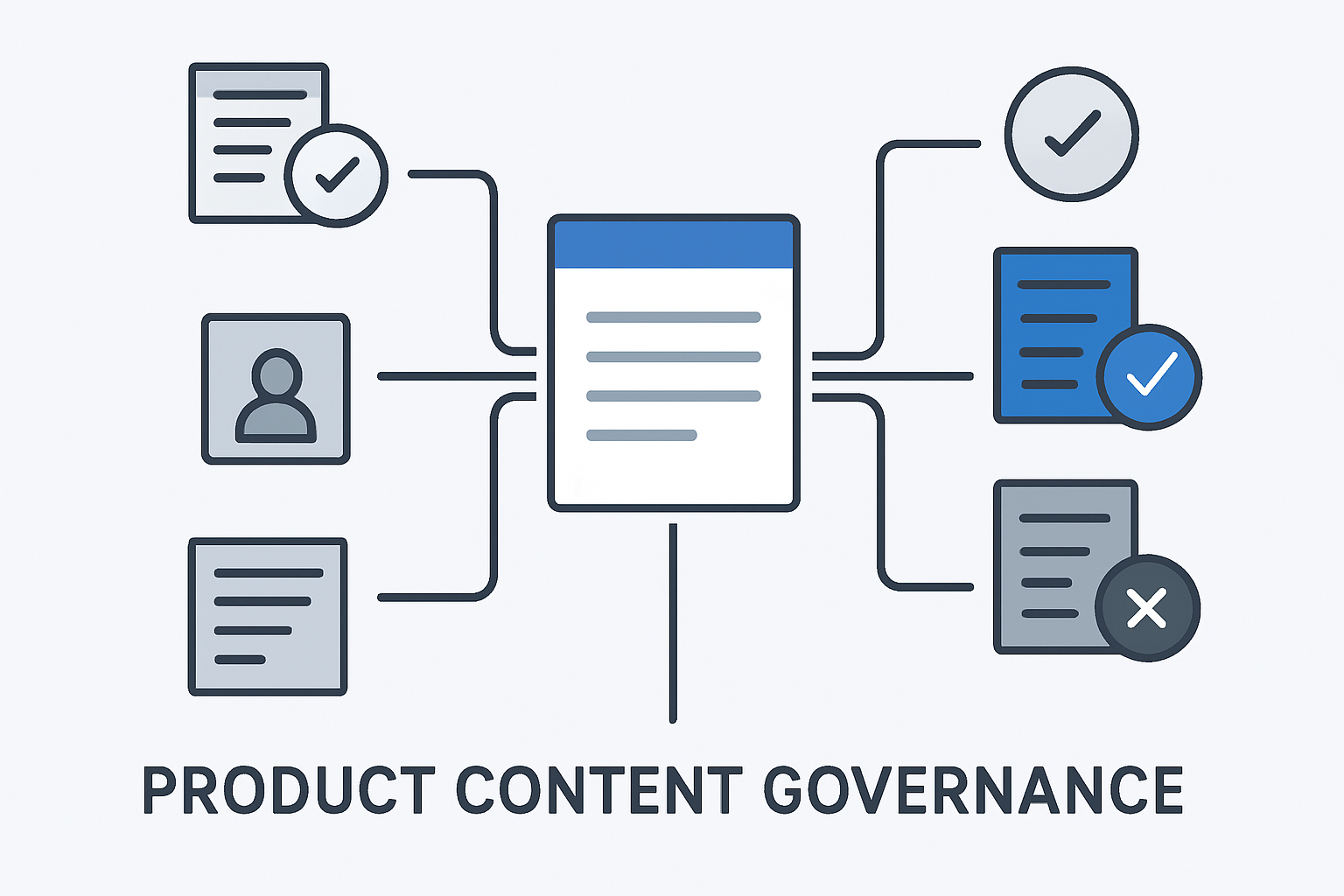
Product content has a shorter tolerance for error than generic editorial content. Pricing logic, availability, ingredients, specifications, compatible accessories, shipping policies, and regulatory claims can change without warning.
Governance is the system that keeps content accurate, consistent, compliant, and useful as those changes happen. It prevents the familiar scenario where a product page says one thing, a collection page says another, and support has to explain the difference.
Assign Clear Roles and Responsibilities
Cross-functional work fails when responsibility is implied. Make it explicit, especially for high-risk content such as claims, ingredients, sizing, returns, safety guidance, and technical compatibility.
Assign one accountable content owner for each priority product or category. Subject-matter experts provide factual inputs. Writers create usable copy. SEO reviewers validate search intent and discoverability. Legal or compliance reviewers approve claims when needed. The analyst reports on the agreed KPI.
A simple rule helps: the person who knows a product detail has changed must know who owns the content update. Without that handoff, accuracy becomes luck.
Create a Review, Update, and Unpublishing Schedule
A review date should be visible on every priority product, category, and support asset. Start with a three-month review interval for important pages, then add trigger-based updates for launches, discontinuations, policy changes, seasonal shifts, and recurring support issues.
Use a recurring content-audit process and evaluation criteria to assess accuracy, usefulness, duplication, search contribution, conversion impact, and maintenance status. When retiring an SEO-relevant page, redirect it to the closest useful alternative rather than creating a dead end.
Changing product data can also create stale or conflicting pages at scale. Teams that spot these issues need a repeatable way to prioritize content strategy for seo fixes that protect product-page visibility.
When governance is breaking down: Shopify and WooCommerce brands with inconsistent product information, declining category visibility, or unclear content ownership may benefit from a custom strategy and technical audit. SEO.DIGITAL identifies the highest-impact content and crawlability fixes, then turns them into a prioritized roadmap tied to revenue.
How to Measure Product Content Strategy Performance
Traffic is evidence of attention, not proof of commercial value. A revenue-driven product content strategy measures whether shoppers progress toward a better decision, purchase, successful use, and repeat purchase.
Match the metric to the asset’s job. A category page and a post-purchase setup guide should not be judged by the same scorecard.
Match KPIs to the Job of Each Content Asset
Use a small number of meaningful metrics per asset. This prevents reporting from becoming a dashboard full of numbers that nobody uses to decide what changes next.
| Content asset | Primary job | KPIs to track |
|---|---|---|
| Category pages | Capture qualified category demand | Impressions, rankings, qualified sessions, organic revenue |
| Product pages | Convert informed shoppers | Add-to-cart rate, conversion rate, revenue per visitor |
| Buying guides | Educate and move shoppers toward a product | Product-page clicks, assisted conversions, email signups |
| FAQs | Resolve friction and support decision-making | Task completion, support-contact reduction, conversion support |
| Post-purchase content | Improve product success and retention | Return reduction, review quality, repeat purchase |
| Brand/editorial content | Build non-branded visibility and authority | Qualified traffic, mentions, links, assisted revenue |
Attribution will not always be perfect, particularly across long buying cycles. That is not a reason to default to pageviews. Use product-page clicks, assisted conversions, path analysis, and revenue by landing page to understand the contribution of content that starts earlier in the journey.
Use Content Audits and User Testing to Find Friction
Metrics tell you where to investigate. They rarely tell you why the problem exists.
When a page has impressions but weak clicks, examine titles, snippets, intent alignment, and competitive alternatives. When a product page gets traffic but low add-to-cart rates, inspect whether shoppers can quickly locate price context, fit details, proof, delivery information, and answers to predictable objections.
Use testing alongside analytics to hear the confusion directly. Ask shoppers to find a suitable product, compare two options, or locate a returns detail. Their hesitation will often expose gaps that keyword data cannot.
Common Product Content Strategy Mistakes
Most content failures are operating failures. Teams produce assets without a decision system, then try to solve the resulting confusion with more output.
Mistake 1: Treating the Content Calendar as the Strategy
A calendar schedules work. It does not define the audience, business objective, journey stage, message architecture, ownership, or measurement plan.
Fix it by documenting those decisions first. Once they are set, your calendar becomes useful because it turns priorities into accountable work rather than a list of publishing dates.
Mistake 2: Writing Product Content Without Customer Research
Internal language is often too technical, too broad, or too flattering to reflect how shoppers actually decide. That creates pages that sound polished but fail to answer the questions buyers type into search or ask support.
Collect customer language before scaling content production. Validate high-stakes product and category content against support themes, reviews, interviews, and observed user behavior.
Mistake 3: Creating More Content Instead of Improving the Right Content
More pages do not automatically create more visibility or revenue. If your core product pages, collections, FAQs, and buying guides are thin, inaccurate, duplicative, or disconnected, volume simply multiplies maintenance work.
Prioritize consolidation, optimization, and gap closure before expanding output. The best next asset may be a revised comparison table or a clearer sizing guide, not another top-of-funnel article.
Mistake 4: Separating SEO, Product, and Brand Content
Search demand, product differentiation, and buyer confidence are not competing goals. A page can meet search intent, state a distinct value proposition, and guide the shopper toward a purchase without becoming keyword-stuffed or overly promotional.
Bring SEO, merchandising, product, and brand into the same brief. Shared terminology, proof points, and page priorities create a more coherent experience and prevent each team from optimizing a different version of the truth.
Product Content Strategy FAQ
What Are the 5 Pillars of Content Strategy?
The five pillars are business purpose and content goals; target audience and customer journey; product information, messaging, and content types; governance, workflow, and ownership; and measurement, maintenance, and optimization. Organizations may use different names, but an effective content strategy must address each function.
What Is the 3-3-3 Rule for Marketing?
There is no single, universally accepted 3-3-3 rule for marketing established by the supplied research. Treat any version you encounter as a narrow planning heuristic, not a replacement for a documented product content strategy with clear goals, ownership, and measurement.
What Are the 7 Steps in Creating a Content Strategy?
The seven steps are audit existing content, define revenue-focused goals, research the target audience and buying barriers, map content to the customer journey, define messaging and guidelines, build the workflow and calendar, then publish, measure, and improve. The order matters because each step supplies evidence for the next.
What Is an Example of a Content Strategy?
A store selling high-consideration home fitness equipment could identify recurring questions about space, setup, and suitability, then build category education, product comparisons, stronger product pages, and setup guides. It would assign owners, distribute the content through search and email, and measure organic revenue, product-page clicks, assisted conversions, and return-related support contacts.
Build a Product Content Strategy That Compounds Organic Revenue
The goal is not more content. It is a controlled product-content system that helps the right shopper discover your offer, understand it quickly, evaluate it confidently, and get value from it after purchase.
When buyer research, product information, SEO, brand standards, governance, and reporting work together, organic content becomes more than a publishing cost. It becomes a predictable acquisition and conversion channel that can reduce dependence on paid media over time.
If you run a Shopify or WooCommerce brand generating $50k+ MRR and need to diagnose organic growth barriers, audit your content and technical foundations, and build a prioritized revenue roadmap, book a call with SEO.DIGITAL for a no-obligation deep-dive consultation.